Vibe Coding• 5 min read
The Dawn of Intuitive Creation: Unpacking the Rise of Vibe Coding
Explore 'vibe coding,' a revolutionary approach to software development where AI generates applications from natural language descriptions.
ALTERED BRILLIANCE IS LIVE.ALTERED BRILLIANCE IS LIVE ON GOOGLE PLAY.Read the product story →
Explore 'vibe coding,' a revolutionary approach to software development where AI generates applications from natural language descriptions.
The year 2026 marks a pivotal moment in software development, heralded by the widespread adoption of vibe coding. Coined by OpenAI co-founder Andrej Karpathy in early 2025, this paradigm shift allows individuals to articulate their application ideas in plain English, empowering artificial intelligence to translate these concepts into functional software. This isn't merely AI-assisted coding; it's a fundamentally new methodology where the user's focus shifts from intricate syntax to iterative design and conceptual feedback.
Karpathy's concise declaration of "vibe coding" in February 2025 resonated deeply, arriving at a time when AI models like Claude Sonnet, GPT-4o, and Gemini were achieving unprecedented levels of code generation. This synchronicity between concept and capability rapidly propelled the term into the mainstream consciousness, culminating in its recognition as Collins Dictionary's Word of the Year by November 2025. The speed of its assimilation underscores a profound demand for more accessible development tools.
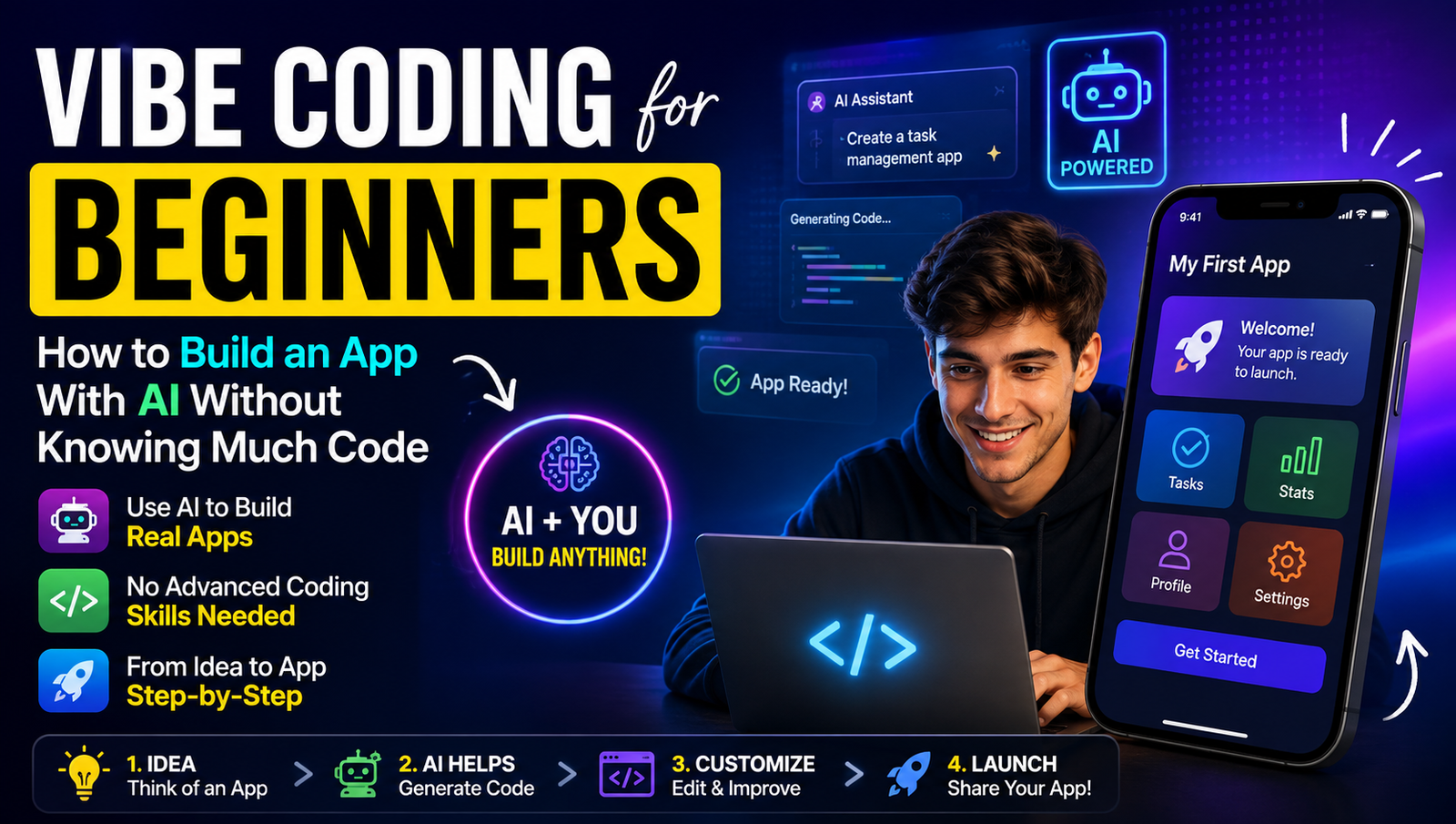
The process of vibe coding is remarkably straightforward. Users engage with platforms like Lovable or Bolt by providing a natural language prompt, such as "build a workout tracker that lets me log exercises, track sets and reps, and shows a weekly summary chart." Within seconds, the AI generates a complete application, including frontend, backend logic, and database structures. The subsequent stages involve testing the generated application and providing conversational feedback to the AI for refinements, effectively bypassing traditional debugging and code-review cycles. Deployment is often integrated, simplifying the path from concept to live application.
While superficially similar to no-code development, a critical distinction lies in their outputs. Vibe coding generates actual, exportable code (e.g., React, Python, SQL), offering developers the flexibility to modify, host, and integrate the codebase independently. Conversely, traditional no-code platforms often confine users to proprietary ecosystems, limiting customization and portability. This flexibility makes vibe-coded applications more adaptable for future scaling or developer collaboration.
By mid-2026, several platforms have emerged as leaders in the vibe coding space. Lovable is celebrated for producing polished Minimum Viable Products (MVPs) with high UI quality. Bolt excels in speed, enabling rapid prototyping and swift idea-to-deployment cycles. Replit offers a comprehensive, all-in-one environment, managing the entire lifecycle from build to deployment. Each platform caters to slightly different priorities, though all generally operate on a subscription model that requires careful cost management due to their resource-intensive nature.
The impact of vibe coding is quantifiable and growing. With tens of thousands of monthly Google searches for the term and significant adoption within major startup accelerators like Y Combinator – where 25% of the Winter 2025 batch reportedly used AI for 95% of their codebase – its influence is undeniable. Esteemed publications such as the BBC, The New York Times, and MIT Technology Review have chronicled its ascent, highlighting its transition from a niche concept to a mainstream technological phenomenon. The Stack Overflow 2024 survey further corroborates this trend, indicating that 76% of developers are already using or planning to adopt AI coding tools.
The practical applications of vibe coding are already materializing. Individuals like Leo Paz have leveraged this technology to launch functional startups, such as Outlit, a sales agent platform. This demonstrates that vibe coding isn't merely a theoretical construct but a viable method for developing robust, market-ready products. The ability to rapidly iterate and deploy complex applications without deep programming expertise democratizes the creation process, opening doors for entrepreneurs and innovators across various sectors.
Looking forward, Andrej Karpathy himself has hinted at the next evolutionary stage: agentic engineering. This concept envisions fully autonomous AI agents handling the entire software development lifecycle, from coding and testing to deployment, with minimal human intervention. This future promises an even greater degree of automation, potentially redefining the very role of human creativity in the technological landscape, shifting it towards high-level conceptualization and strategic oversight rather than granular implementation. The journey of software creation continues to accelerate and evolve, driven by these groundbreaking AI advancements.
Source Insight: This report was curated based on original coverage from nocode.mba.
Source: nocode.mba