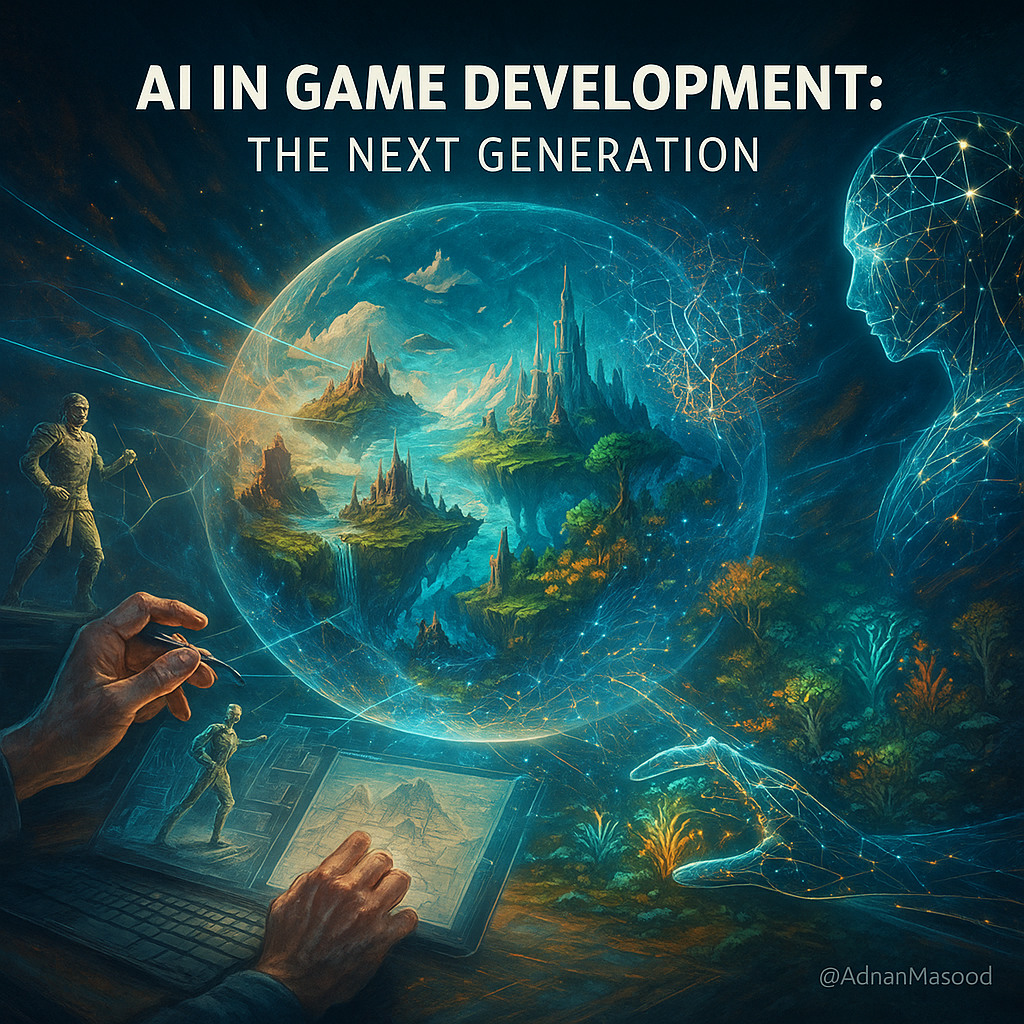
The landscape of open-world game development has long been a quest for ever-expanding scale, unparalleled realism, and unfettered player agency. While procedural generation offered a pathway to vast landscapes and handcrafted narratives anchored story quality, a monumental shift is now underway. The synergistic convergence of Neural Radiance Fields (NeRFs) and Large Language Models (LLMs) is ushering in an unprecedented era of collaborative world-building, where environments, storylines, and gameplay mechanics evolve with striking autonomy.
Foundations of a New Reality
At its core, NeRF technology fundamentally redefines how 3D scenes are represented. Moving beyond traditional polygon meshes, NeRFs employ neural networks to encode intricate color and density fields. This allows for the reconstruction of extraordinarily rich and detailed 3D environments from mere sparse inputs, making them ideal candidates for generating photorealistic landscapes, intricate structures, and immersive interiors. Concurrently, LLMs, exemplified by models such as GPT, possess the remarkable capacity to generate sophisticated narrative arcs, contextually appropriate character dialogue, and dynamic quests that respond directly to player actions. The true alchemy occurs when these two formidable technologies are interwoven, fundamentally transforming the methodology by which game worlds are conceived, experienced, and maintained.
The Symphony of Co-Generation
Central to the NeRF + LLM paradigm is the concept of real-time co-generation. In this collaborative dance, LLMs articulate the environmental logic and narrative intent, while NeRFs meticulously render the physical manifestation of these ideas into explorable, tangible spaces. Consider, for instance, an AI-originated medieval realm. The LLM might dictate that a severe drought afflicts a farming village, consequently generating compelling dialogue, fostering factional disputes, and weaving emergent quests. In perfect synchronicity, the NeRF engine would then procedurally craft the physical environment: parched riverbeds, fissured earth, wilting flora, and a somber, low-fog atmosphere—all dynamically reflecting the narrative state. This paradigm shifts game design from static pre-authored content to synchronously dynamic and self-actualizing worlds.
Unlocking Adaptive Storytelling
One of the most compelling advantages of this integrated approach is its profound impact on adaptive storytelling. Traditional open-world narratives are inherently constrained by their pre-scripted limitations. However, LLM-driven systems can meticulously analyze player behavior, discern emotional tones, identify preferred playstyles, and recall prior decisions to dynamically forge entirely new narrative branches. When seamlessly integrated with NeRF-based scene generation, the environments themselves morph and adapt to support these player-driven narrative outcomes. Quests transcend their former guise as linear tasks, transforming into fluid, evolving experiences deeply rooted in the persistent state of the world. This propulsion moves games decisively toward truly emergent narrative structures, where each playthrough becomes an utterly unique and unrepeatable journey.
Revolutionizing Asset Creation
Another significant dividend of this collaboration is the radical reduction, if not outright elimination, of costly asset pipelines. The development of a modern AAA open-world title typically demands the painstaking creation of thousands of manually modeled assets, numerous environmental passes, intricate prop placement, and countless lighting iterations. With NeRF systems capable of being trained on real-world scans or procedurally synthesized data, developers can generate entire regions or diverse biomes with remarkably minimal manual intervention. LLMs can simultaneously conjure compelling lore, intricate settlement designs, complex factional relationships, and extensive resource networks, while NeRFs render corresponding dynamic architectural styles and geometric complexities. This allows development teams to strategically pivot their focus from the arduous task of asset creation to the more impactful realm of high-level creative direction and innovative gameplay design.
The Future of Live-Service Gaming
The collaborative NeRF + LLM framework is particularly potent for the evolving domain of live-service games. Rather than developers dedicating months to manual map expansions, LLM systems can intelligently anticipate player trends and dynamically generate novel content on demand. NeRF-rendered regions could be streamed in at runtime, mirroring the way current open-world games stream terrain, thereby facilitating effectively infinite exploration. Entire seasonal story arcs could be generated dynamically, moving beyond the confines of pre-produced content cycles, offering players an ever-fresh and evolving experience.
Navigating the Horizon of Challenges
Despite its transformative potential, the integration of NeRFs and LLMs is not without its formidable challenges. Real-time NeRF rendering demands substantial computational power and sophisticated optimization strategies. While advancements like Instant-NGP, mip-NeRF, and various level-of-detail NeRF representations offer promising avenues, they remain computationally intensive. Furthermore, LLMs must demonstrate an unwavering capacity to maintain narrative coherence across extended play sessions, necessitating robust persistent world memory systems. The overarching endeavor to ensure that AI-generated content feels consistently meaningful, intentional, and emotionally resonant remains a crucial and active area of research.
Authorship and the Human Touch
Questions regarding authorship, creative control, and design oversight also loom large. Developers must meticulously establish guardrails that permit the expansive creativity of LLMs while simultaneously safeguarding artistic direction and ensuring balanced gameplay mechanics. Future development tools will likely gravitate towards hybrid pipelines, fostering a symbiotic collaboration where human world-builders establish core visual themes, define biome rules, and dictate narrative tone, while AI systems intelligently populate and contextualize content at an unprecedented scale.
A Glimpse into Living Ecosystems
As we look ahead, the confluence of NeRF and LLM technologies heralds a monumental paradigm shift in interactive entertainment. Games are poised to transcend their traditional role as static environments, evolving into living, intelligent ecosystems. Players will soon traverse worlds that actively grow, believably decay, intelligently adapt, and profoundly respond to their presence and actions. The once distinct boundary between authored narrative and emergent systems will increasingly blur, birthing experiences that feel strikingly akin to genuine alternate realities. What procedural generation initiated decades ago, the collaborative power of NeRF and LLM technologies stands poised to finally bring to its complete and breathtaking fruition.
Source Insight: This report was curated based on original coverage from daydreamsoft.com.