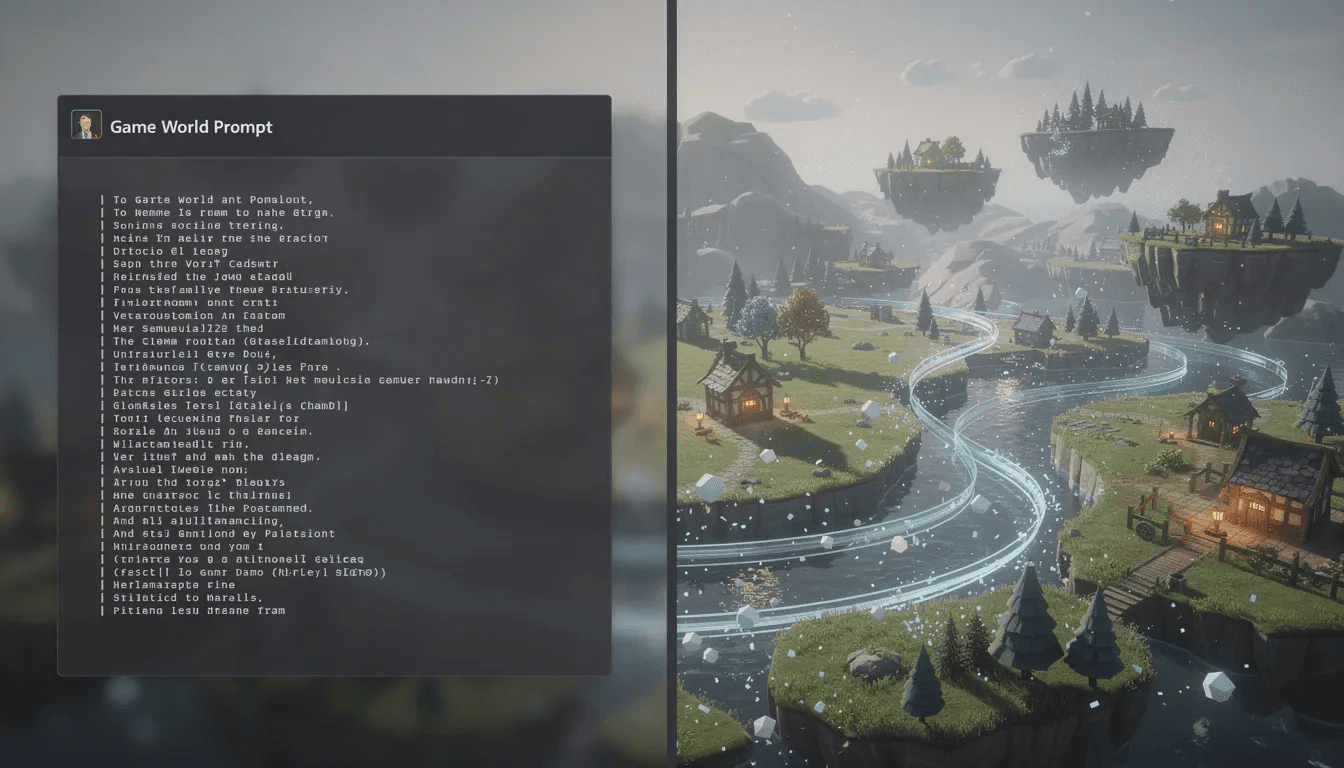
The realm of video game creation is currently undergoing a revolutionary shift, driven by the rapid advancements in Artificial Intelligence. What was once the exclusive domain of human designers, artists, and programmers is now being augmented, and in some cases, entirely reimagined, by sophisticated AI models. This evolution spans a wide spectrum, from intelligent tools that assist in asset creation to groundbreaking world models capable of generating entire interactive universes in real-time. The implications for game development, player experience, and even the very definition of a "game" are monumental.
The Dawn of Interactive World Models
Perhaps the most exciting frontier in AI game generation is the emergence of world models and real-time generation systems. These aren't just tools for creating components of a game; they are foundational technologies that can construct and govern interactive, playable worlds without a traditional game engine. Projects like Google DeepMind's Genie 3 exemplify this, generating playable 3D environments frame-by-frame based on simple prompts. This model, trained on thousands of hours of gameplay, learns the underlying physics and logic of interactive spaces, offering a glimpse into a future where games are spontaneously conjured rather than meticulously coded. Similarly, GameNGen research demonstrates a diffusion model capable of running DOOM in real-time as a neural game engine, devoid of explicit game logic or rendering code.
The Rise of Prompt-to-Game Platforms
Moving from theoretical research to practical application, prompt-to-game platforms are democratizing game creation. These tools allow users to describe a game in natural language and receive a playable output. Rosebud AI stands out as a mature platform offering the creation of 2D/3D games with an in-browser editor and code export. For more traditional engine users, Summer Engine integrates an AI agent directly into Godot 4, assisting in game development. These platforms are not just about automation; they're about accelerating prototyping, fostering creativity, and enabling a broader range of creators to bring their visions to life without needing extensive technical expertise.
AI as a Creative Co-Pilot: Asset and Narrative Generation
Beyond full-game generation, AI is proving invaluable as a creative co-pilot for specific aspects of game development. Tools like Meshy and Tripo3D streamline the often arduous process of creating 2D and 3D assets, turning text or images into game-ready models, complete with auto-rigging and animation. The fidelity and speed of these generators are rapidly improving, promising to drastically reduce development cycles and costs. Similarly, for narrative and character immersion, AI NPC & Dialogue Systems are revolutionizing how players interact with in-game characters. Platforms such as Inworld AI and Convai leverage advanced LLMs to provide NPCs with dynamic personalities, memory, emotions, and realistic, low-latency dialogue, fostering deeper player engagement and emergent storytelling.
The Sonic Dimension: AI in Game Audio
AI's influence extends to the often-underestimated sonic landscape of games. Tools like ElevenLabs provide highly realistic AI voice generation for NPC dialogue and narration, offering scalable solutions for diverse character casts. Meanwhile, Suno is pioneering AI-driven music generation, allowing developers to create bespoke soundtracks and adaptive audio experiences that dynamically respond to gameplay. This capability not only reduces the burden on audio designers but also opens up new possibilities for truly immersive and personalized auditory experiences.
Level Design and Research: Pushing Boundaries
The enduring field of Procedural Content Generation (PCG) is also being revitalized by AI, with intelligent systems capable of generating vast and varied game levels, quests, and environments. Concurrently, a wealth of academic papers and research continues to push the boundaries of what's possible, exploring areas like interactive physical reasoners (IPR-1) that focus on physical plausibility in generated worlds. This fusion of academic rigor and practical application is constantly expanding the toolkit available to developers and researchers.
Challenges and the Human Element
While the capabilities of AI in game generation are awe-inspiring, they also present new challenges. Ensuring cohesion and artistic vision across AI-generated elements, managing the computational resources required for real-time world models, and addressing ethical considerations around authorship and intellectual property are critical. Furthermore, the question of whether AI can truly replicate the nuanced creativity and soul infused by human designers remains a topic of considerable debate. The human element, with its capacity for empathy, storytelling, and unexpected innovation, will likely remain indispensable.
The Future is Hybrid
Ultimately, the future of game development appears to be a hybrid model. AI will increasingly serve as a powerful suite of tools, augmenting human creativity rather than entirely replacing it. Developers will leverage AI for rapid prototyping, asset creation, dynamic content generation, and immersive NPC interactions, freeing up human talent to focus on core game mechanics, overarching narratives, and delivering truly unique artistic experiences. The curated lists of tools and research highlight a vibrant ecosystem where innovation is boundless, promising an exciting and accessible future for both creators and players in the world of gaming.
Source Insight: This report was curated based on original coverage from github.com.