The global gaming industry has roared back to life in the first quarter of 2026, recording a staggering $7.7 billion in merger and acquisition (M&A) transactions across 52 deals. This impressive figure, highlighted in Aream & Co.'s Video Game Market Update Q1 2026 report, marks a post-pandemic record for quarterly deal value, surpassing all quarters since the end of the COVID-19 pandemic when excluding mega-deals like Microsoft's acquisition of Activision Blizzard.
The Mobile Sector's Dominance
Notably, this resurgence is largely propelled by the mobile gaming sector, which accounted for the lion's share of transaction value. The Saudi-backed Savvy Games Group emerged as a pivotal player, driving substantial M&A activity. Their monumental $6 billion acquisition of Moonton set a new benchmark, while their subsidiary Scopely's $1 billion purchase of Loom Games further underscored the strategic importance of mobile IP and talent. Beyond these titans, other significant mobile transactions included NCSoft's $202 million acquisition of a 70% stake in JustPlay, Mattel's move to fully own Mattel163 for $159 million, and Nazara's agreement to acquire a 50% controlling stake in Bluetile for $100 million.
Investment Trends and Market Headwinds
While M&A activity soared, other investment avenues presented a more mixed picture. Public offerings remained subdued, totaling $1 billion across 11 deals, reflecting broader macroeconomic headwinds. The report attributes this to an AI-driven market rotation and a general decline in gaming stocks mirroring the wider software sector's sell-off. Private investments, though growing year-over-year, saw a quarter-on-quarter decline to $800 million across 101 deals, with venture capital-led deals in early-stage companies hitting a post-pandemic low. Despite this, firms like Arcadia, Bitkraft Ventures, and Griffin remained active in the early-stage investment landscape.
Shifting Platform Revenues
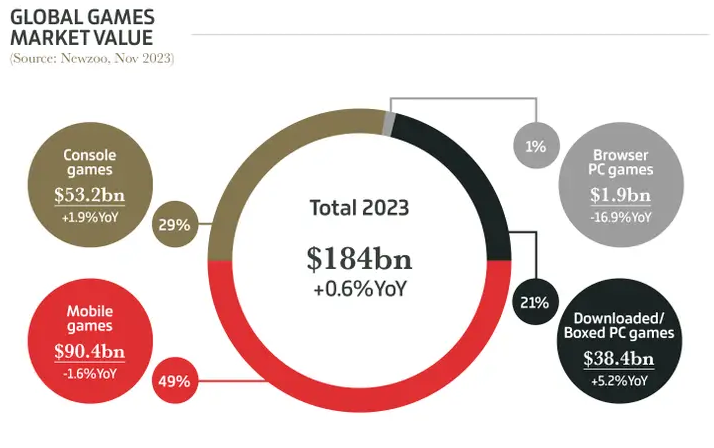
The Aream & Co. report also offered intriguing insights into platform revenue performance. Steam and console gaming demonstrated robust growth, with console revenue remarkably surpassing in-app purchase earnings on mobile for the first time in a while. Steam recorded an all-time quarterly high of $5.6 billion, primarily driven by Western developers. The console market, boosted significantly by the unprecedented success of the Switch 2 which generated $21.7 billion, managed to offset declines in PlayStation 5 and Xbox sales. This propelled console revenues past mobile's $20.5 billion in in-app purchase revenue for the quarter.
Mobile's Enduring Resilience
Despite being overtaken by console in this specific metric, mobile gaming showcased its enduring resilience, maintaining its seventh consecutive quarter above $20 billion in revenue. This consistent performance underscores mobile's foundational role in the gaming ecosystem, even as download figures saw a year-over-year dip. The report highlighted Loom Games, Microfun, and Century Games as top-growing publishers in the U.S., with Bandai Namco and Voodoo also making significant strides. Furthermore, the increasing revenue share of mobile studios in Asia and Türkiye points to a continuing shift in global development and market influence.
The Strategic Imperative of Consolidation
The overarching theme of Q1 2026 is the strategic imperative driving this wave of consolidation. Companies are clearly focusing on acquiring proven intellectual properties, expanding their market reach, and integrating synergistic technologies. The substantial investments, particularly from entities like Savvy Games Group, suggest a long-term vision for shaping the future of interactive entertainment. This trend could lead to a more concentrated market, potentially fostering both innovation through resource pooling and heightened competition among larger entities.
Psychological and Industry Implications
From a wellness perspective, this level of industry consolidation can have multifaceted impacts. Larger, more stable companies might offer greater job security and resources for employee well-being initiatives. However, it also raises questions about creative diversity and the potential for a more homogenized gaming landscape if smaller, independent voices are subsumed. The focus on established mobile IPs, for instance, reflects a preference for reliable revenue streams in a volatile economic climate, which could influence the types of games that receive significant investment and promotion.
Looking Ahead
The exceptional M&A activity in Q1 2026 signals a definitive shift from the cautious approach seen in previous quarters. It suggests that despite broader economic uncertainties, the gaming industry remains a hotbed for strategic investment and growth. As the market continues to evolve, propelled by both internal innovation and external financial dynamics, stakeholders will be keenly watching how these significant mergers and acquisitions reshape the competitive landscape and ultimately, the player experience. The coming quarters will reveal whether this record-setting pace is a fleeting anomaly or the beginning of a sustained period of aggressive expansion and consolidation.
Source Insight: This report was curated based on original coverage from pocketgamer.biz.