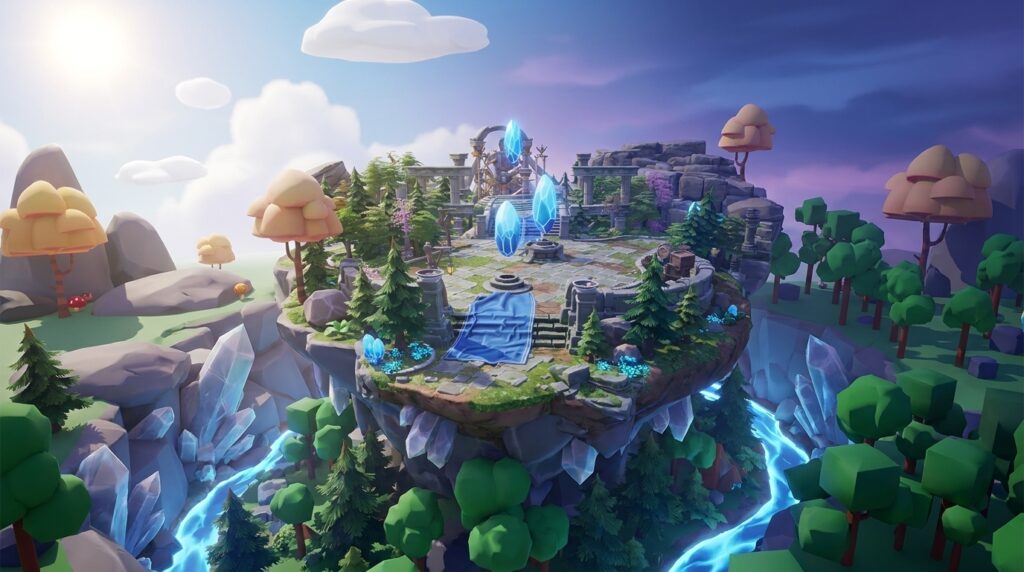
The gaming industry stands on the precipice of its next great transformation, a paradigm shift driven by the relentless advancement of artificial intelligence and procedural generation. For decades, video games have not merely entertained but have profoundly influenced consumer behavior and acted as a powerful catalyst for technological innovation. From pushing the boundaries of real-time 3D rendering with NVIDIA GPUs to pioneering online social experiences, gaming has consistently been at the forefront of digital evolution. As we increasingly inhabit immersive virtual worlds, the "infinite power of play" is becoming more manifest than ever, solidifying gaming's pivotal role in how we connect, learn, and engage with technology.
Gaming as an Innovation Engine
Many life-altering technologies have their roots in gaming. The interactive nature of video games inherently pushes the limits of what's technologically possible, fostering an environment where innovation thrives. The interplay between 'play' as safe exploration and 'work' as the exploitation of learned patterns mirrors the very mechanisms of AI itself. A prime example is NVIDIA, which, originally conceived to handle complex 3D calculations for games, has evolved into the computational backbone for AI, blockchain, and countless other advanced technologies. This symbiotic relationship highlights gaming's unique position as both a consumer vertical and a crucial incubator for groundbreaking tech.
A Platform Shift, Not Just an Improvement
While the gaming industry has seen steady growth and technological advancements, the advent of AI represents something far more profound than incremental improvements. It is a platform shift on par with the emergence of the consumer internet or the widespread adoption of the smartphone. Historically, such shifts don't just make existing processes faster or cheaper; they enable the creation of *completely novel, previously impossible user experiences*. Consider the rise of companies like Zynga with mobile gaming or Rovio with tactile touchscreen experiences – newcomers who leveraged new realities to carve out dominant market positions, often leaving established incumbents struggling with corporate inertia.
The Rise of Intelligent NPCs and Generative Worlds
In this new era, we can anticipate the arrival of intelligent non-player characters (NPCs) and generative agents that transcend pre-programmed decision trees and limited narrative choices. These aren't just more sophisticated algorithms; they represent a fundamental reimagining of in-game interaction. What seems like a distant fever dream today – characters that truly learn, adapt, and converse dynamically – will soon become commonplace, a new table stakes for immersive gaming. Developers who fail to embrace these capabilities risk being left behind as audiences increasingly gravitate towards the most engaging and responsive virtual worlds.
Accelerating the Velocity of Game Creation
The AI platform shift is also set to dramatically accelerate the velocity of game creation. This can be understood as the 4th Industrial Revolution of Video Games, building upon a rich history of development methodologies. Early gaming, characterized by the Publisher Model, resembled a 'Stone Age' where monolithic architectures and siloed development led to ballooning budgets and a focus on known core markets. This often stifled creative risk-taking and diversification.
Modularization: A Precursor to AI's Impact
The first significant shift away from monolithic development came with modularization, exemplified by the widespread adoption of licensed game engines like *id Software's Doom* and *Quake Engines*, and later *Epic Games' Unreal Engine* and *Unity*. This allowed developers to abstract environmental creation, speeding up processes and fostering the rise of indie game developers. Tools like *Adobe Flash*, *GameMaker Studio*, and distribution platforms such as *Steam* and *XBox Live* further empowered smaller teams, shifting the focus from low-level systems to compelling game mechanics and assets. This modular approach reduced costs and increased development agility, a trend that AI is now poised to amplify.
The Future of Game Development: Beyond Standardization
The benefits of modularization, including increased development speed and agility, are expected to persist and expand. By standardizing certain aspects of game development, we anticipate an even faster pace of iteration and a greater scope for individual developers, particularly in the realm of live-service games. However, AI's influence will move beyond mere standardization. It will enable entirely new forms of content generation, asset creation, and iterative design, fundamentally altering the developer workflow. Imagine tools that can instantly generate variations of environments, characters, or quests based on high-level directives, freeing creators to focus on narrative depth and innovative gameplay mechanics.
Implications for the Player Experience
For players, this translates into experiences of unprecedented depth, personalization, and emergent gameplay. Games will become more reactive, dynamic, and genuinely unique to each player's journey. The boundaries between static content and living, breathing virtual worlds will blur, offering a level of immersion that current technology can only hint at. This evolution promises not just better games, but a reimagining of what interactive entertainment can truly be, fulfilling the long-held promise of truly intelligent and responsive virtual companions and ever-evolving digital realms.
Source Insight: This report was curated based on original coverage from lsvp.com.