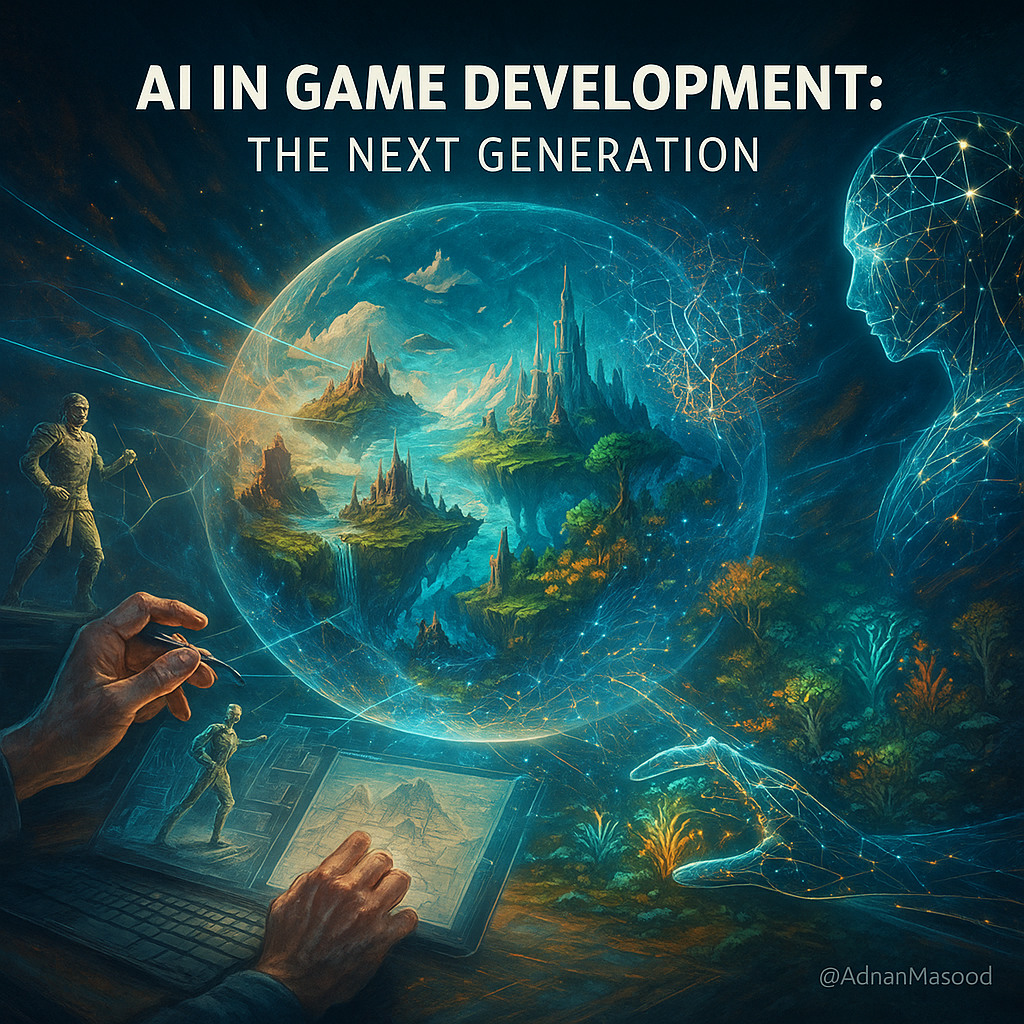
The gaming landscape is on the precipice of its most profound transformation since the advent of online multiplayer. At the heart of this revolution lies artificial intelligence, not merely as a peripheral enhancement but as a foundational pillar reshaping player experiences. We are moving beyond scripted interactions to worlds where NPCs exhibit genuine awareness, memory, and adaptive behavior, mirroring the complexity of human interaction. This shift heralds an era of unprecedented immersion and personalization, driven by advanced AI frameworks that extend far beyond simple decision trees.
The Nuance of Next-Gen AI in Gaming
To fully grasp the magnitude of this change, it's crucial to differentiate between traditional game AI and the generative AI now being integrated. For decades, game AI operated on deterministic logic: an NPC performed action X when the player initiated action Y. This predictable, rule-based system, while effective, created an inherent ceiling on emergent gameplay. Modern AI, however, leverages trained neural models that produce novel, contextually appropriate responses to previously unseen inputs. Think of it not as a pre-programmed actor, but as an improvisational performer, reacting uniquely to every moment.
The Four Pillars of AI Integration
Contemporary AI in games, slated for widespread adoption by 2026, functions across four distinct, yet interconnected, layers:
* Language Model NPCs: Characters powered by Large Language Models (LLMs) can generate unique dialogue, maintain conversational context, and adapt their personality based on a player's history and choices. This creates truly dynamic and responsive virtual companions or adversaries.
* Generative World Building: AI systems are increasingly responsible for procedurally generating quests, storylines, level layouts, and intricate world details. These environments and narratives adapt fluidly to player decisions, offering a personalized experience with every playthrough.
* Behavioral ML Systems: Neural networks analyze individual player skill patterns in real-time, dynamically adjusting enemy behavior, encounter frequency, and overall challenge scaling. This ensures a constantly optimized difficulty curve, preventing frustration or boredom.
* Neural Physics Simulation: AI-driven motion synthesis creates astonishingly natural character animations and object physics responses. This goes beyond pre-recorded animations, generating fluid and believable movements that no animator could hand-craft for every conceivable scenario.
NVIDIA ACE and the NPC Revolution
Perhaps the most immediately visible impact of this AI revolution is in NPC dialogue. Systems like NVIDIA ACE (Avatar Cloud Engine), alongside competitors such as Convai and Inworld AI, employ a sophisticated architecture. An LLM is given a detailed character definition – encompassing personality, backstory, knowledge boundaries, and speech patterns – and then responds to player input within these constraints. A critical, often overlooked detail is contextual persona locking, where the character's knowledge horizon is defined, ensuring a medieval tavern keeper doesn't discuss modern technology without explicit programming. This maintains narrative coherence and deepens immersion.
Furthermore, NVIDIA's decision to design ACE for local inference on the player's RTX GPU is a game-changer. This shifts the substantial computational cost of AI NPCs from the publisher's servers to the player's hardware, fundamentally altering the economics of live-service games and potentially democratizing access to highly advanced NPC interactions.
Beyond Dialogue: The Generative World Frontier
While intelligent NPCs grab headlines, the procedural AI content generation is arguably more technically profound. Google DeepMind's 2024 research on *Generative Agents: Interactive Simulacra of Human Behavior* demonstrated NPCs capable of forming genuine episodic memories across play sessions and modifying their behavior based on accumulated experience. These agents, placed in a simulated town, formed relationships and coordinated activities without explicit social programming, hinting at a future where game worlds are truly alive and evolving.
Tools for Creation: Promethean AI
The impact extends to game development itself. Promethean AI, now acquired by a major studio, allows environment designers to describe scenes in natural language, prompting AI to autonomously place, scale, and texture assets. Imagine describing "a crumbling medieval marketplace at sunset with merchant stalls and scattered debris" and having a populated, coherent 3D environment generated instantly. This technology dramatically accelerates development cycles and empowers smaller indie teams to create expansive, open-world environments that previously required vast resources, promising an imminent "indie AI game wave."
The Latency Challenge and Future Solutions
Despite these advancements, challenges remain. Input latency in LLM-powered NPC responses, typically ranging from 0.8 to 2.5 seconds, can disrupt conversational immersion. Solutions are emerging, including local small LLMs running directly on player GPUs (as seen with NVIDIA ACE) and speculative decoding, where likely response candidates are pre-generated while the player is still speaking. These innovations are crucial for seamless, real-time interaction, ensuring that the magic of AI-driven worlds isn't broken by technical delays.
This confluence of LLM-powered characters, generative world-building, adaptive behavioral systems, and realistic neural physics marks a paradigm shift. The future of gaming is not just about improved graphics or larger maps; it's about fundamentally rethinking interaction, narrative, and the very fabric of virtual realities through the power of AI.
Source Insight: This report was curated based on original coverage from solidaitech.com.