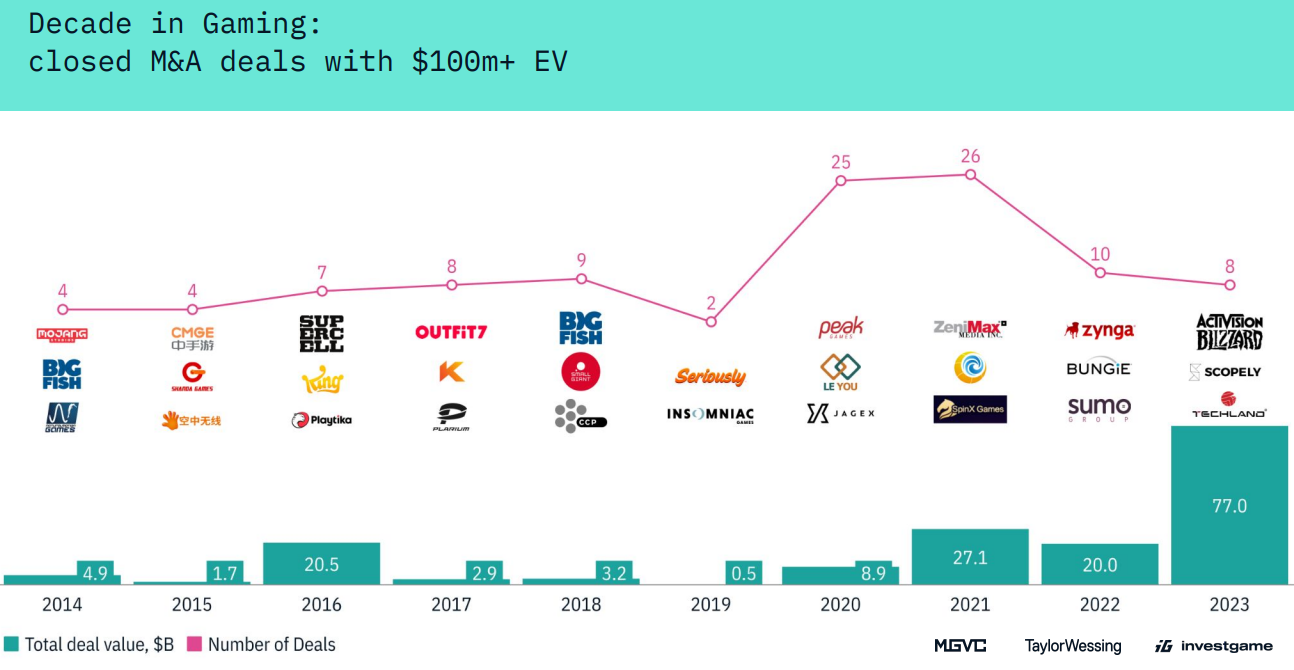
The global video game industry continues to demonstrate remarkable resilience and adaptability, as evidenced by its financial performance in the second quarter of 2026. Mergers and acquisitions (M&A) reached a substantial $2.3 billion across 54 transactions, marking the highest level of overall deal activity since 2022, according to Aream & Co's *Video Game Market Update Q2 2026*. This resurgence is not fueled by isolated mega-deals, but rather by a robust and strategic mid-market boom, where acquisitions exceeding $100 million are at a post-pandemic high. This trend indicates a maturing market where companies are actively diversifying and fortifying their portfolios, rather than simply pursuing opportunistic growth.
Strategic Acquisitions Define the Quarter
Among the quarter's most significant transactions, *Scopely* finalized its acquisition of *Loom Games* for an impressive $1 billion, underscoring the value placed on established mobile and casual game developers. Additionally, a notable $591 million stake sale saw a *WeMade* founder's share transferred to *NeoPulse*, highlighting continued investor confidence in key industry players. While the total M&A figure for Q2 2026 is lower than the $7.7 billion recorded in the preceding quarter, that previous sum was heavily influenced by *Savvy Games Group's* extraordinary $6 billion buyout of *Moonton*. Excluding this outlier, Q2's activity presents a more distributed and healthier market, suggesting broader opportunities for studios seeking strategic exits and growth.
Mid-Market Momentum and Diverse Deals
Beyond the leading transactions, several other mid-market deals contributed significantly to the quarter's multi-billion-dollar total. *JustPlay* was acquired in a $289 million transaction, while *Nazara* expanded its influence by securing a controlling $201 million stake in *Bluetile*. The independent publisher *Playstack* also found a new home, acquired by TPG|imc for $168 million. Notably, *Fenris Creations* executed a $120 million management buyout, backed by prominent tech entities like CCP and DeepMind. These diverse acquisitions illustrate a strategic drive across various segments of the gaming ecosystem, from mobile to independent development.
The Surge in AI and AdTech Investment
Beyond traditional studio acquisitions, the financial landscape surrounding the gaming industry saw an unprecedented surge in private investment. This capital infusion, approximately six times year-over-year, reached a staggering $3.1 billion across 108 deals. The bulk of this investment was directed towards gaming-adjacent infrastructure, rather than direct game development. *AppsFlyer*, an AdTech firm, single-handedly raised $1 billion, while AI companies such as *General Intuition Odyssey* and *Decart* collectively secured over $930 million. This pronounced shift underscores a broader industry recognition of the critical role that advanced technologies like AI and sophisticated advertising platforms will play in the future of gaming, impacting everything from game development to player engagement and monetization.
Public Markets Rebound and Emerging Trends
The public markets, after a prolonged period of subdued activity, also demonstrated signs of a strong recovery. Initial Public Offerings (IPOs) collectively reached $1.7 billion across 25 deals, representing a 72% jump in value and a 67% increase in deal count compared to the same quarter last year. *Liftoff* successfully completed its IPO, and *PlaySimple* announced its plans for a Q3 IPO, indicating renewed investor confidence in public offerings within the gaming sector. This resurgence suggests a market beginning to recalibrate after previous uncertainties, offering new avenues for growth and capital generation.
Mobile Sector Challenges Persist
Despite the overall positive investment trends, certain segments of the gaming market continued to face headwinds. Gaming stocks experienced a broader decline, with mobile-first Western publishers seeing a 13% year-to-date drop, and their Asian counterparts plummeting between 37% and 42%. Conversely, large-cap diversified companies demonstrated greater stability, posting a 24% gain. The mobile sector also contended with consumer-level struggles; quarterly gross in-app purchase revenue declined 4% year-over-year, and game installs hit multi-year lows, dropping by 12%, according to *Pocketgamer.biz*.
Pockets of Mobile Growth
Even amidst these challenges, certain players within the mobile space managed to thrive. Companies such as *Voodoo*, *Roblox*, and *Boltray Games* were identified as the top-growing publishers in the United States, based on incremental in-app purchase revenue. Geographically, Singapore and Turkey emerged as nations with the fastest-growing publisher headquarters worldwide, showcasing growth rates of 32% and 25% respectively. These examples highlight that while the mobile sector faces overall contraction, innovation and strategic market positioning can still yield substantial success.
The Evolving Landscape
Overall, Q2 2026 paints a picture of a dynamic and evolving gaming industry. The shift towards a robust mid-market in M&A, coupled with significant private investment in AI and AdTech, signals a strategic pivot towards infrastructure and innovation. While the mobile sector experiences growing pains, the resilience of large-cap companies and the resurgence of public markets suggest an industry continuously adapting and identifying new avenues for growth and value creation. The emphasis is clearly on building sustainable ecosystems and leveraging cutting-edge technology to shape the future of interactive entertainment.
Source Insight: This report was curated based on original coverage from respawn.outlookindia.com.